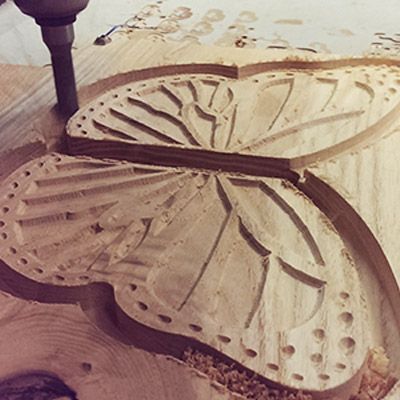
Ce mois-ci, nous avons eu le plaisir de rencontrer Marty et Andy Hartman, père et fils, alias Locust Lane Woodworking. En combinant les compétences d'Andy en ingénierie et le savoir-faire de son père en matière de travail du bois, ils ont su créer des projets plus originaux, intéressants et personnalisés. Avant de nous pencher sur l'un de leurs plus beaux projets, Andy nous a expliqué comment leur collaboration père-fils a débuté…
Locust Lane Workworking est une entreprise familiale, composée de Marty et Andy. Marty travaille le bois depuis toujours, mais il y a une dizaine d'années, l'idée de s'équiper d'une machine CNC lui est venue. Il fréquentait les salons du bois de la région de Baltimore, où Legacy présentait souvent son matériel. Finalement, il a franchi le pas et acheté une de leurs machines CNC. Bien qu'il ait toujours eu une grande expertise en menuiserie, il était un parfait novice en informatique, se comparant lui-même à un Amish déconnecté du monde numérique.A former software engineer, Andy was quite experienced with using the computer, and quick to learn new software, but lacked the skill and experience of his father with woodworking. However, the two of them made a good team, with Andy patiently helping his father get more proficient with software, and Marty supplying the expertise with all matters related to woodworking. Generally, after collaborating with Marty, Andy designs the projects in VCarve Pro, and Marty does all the cutting, gluing, sanding, and finishing. Sometimes painting is done by sister Erica, making it an affair of the whole family.
Locust Lane are in the unique position of being able to supply their own material for their projects as Andy continues to explain below.Marty possède 7 acres de terrain dans la campagne pennsylvanienne, une région riche en frênes, cerisiers, chênes, noyers et peupliers. Il dispose également d'une scierie mobile WoodMizer et d'un séchoir à bois. Il abat les arbres morts, mourants ou en fin de vie, débite les grumes en planches, les sèche au séchoir et utilise le bois pour ses projets sur la machine CNC. Souvent, le processus, de l'arbre au produit fini, se déroule directement sur le terrain. Nous possédons une machine CNC Legacy Arty 36 et utilisons principalement VCarve Pro, mais aussi occasionnellement un logiciel de Legacy appelé Conversational CAM. Pour une meilleure organisation, Marty a construit un support pour toutes les fraises, les rendant ainsi facilement accessibles. Nous l'appelons affectueusement le « Bunker à Fraises » (voir à droite).From growing the business to sourcing material, Marty and Andy have a very organic way of working, which allows them to keep every part of their work 'in-house'. By posting on the Vectric User Forum (username 'llwood') we regularly see what they have been working on. At the base of the page you can see images of some more examples of their excellent work. Before that though we took the opportunity to ask them about a particular project that caught our eye, a Butterfly Box with a wooden hinge, they went onto explain...
As Andy was going through his garage, he came across a metal box (that belonged to his in-laws) that provided the inspiration. I figured there was no reason why this couldn't be done in wood.Meanwhile, a guy named Glenn (username Glenninvb) posted a Dresser Box design on the Vectric Forum VCarve Pro Gallery that used a wooden hinge. This wooden hinge was cut with a 1/8 end mill, and Glenn posted the files for his hinge design. Glenn's hinge connected 2 pieces of wood, but I figured there was no reason that it couldn't be modified to connect three pieces, a base and two movable lids. This would allow each lid to be opened independently or both together like actual butterfly wings.
I originally thought to have the hinge attachments on the top of the wings, but Marty had envisioned a hinge design that hid the attachments altogether so that only the round spine of the hinge showed. This worked perfect for the butterfly, because the round spine of the hinge looks like the body of the butterfly. Marty found that it works better to place a piece of cardboard under the wings when gluing on the hinge pieces. Otherwise, it fits too tightly.Andy a trouvé une belle photo de papillon monarque sur Internet et l'a utilisée comme modèle pour sculpter le dessus des ailes avec VCarve. Les fonctionnalités de VCarve Pro qui nous ont été les plus utiles pour ce projet sont la vectorisation d'images bitmap et le lissage de vecteurs, le décalage et la trajectoire d'outil VCarve.
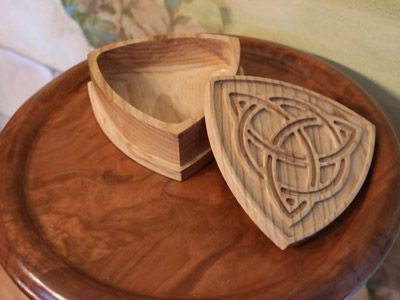
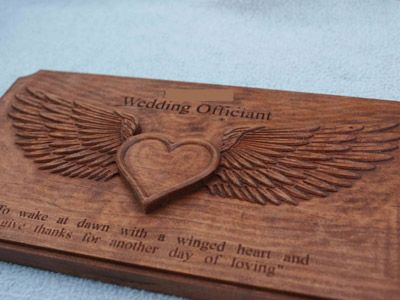
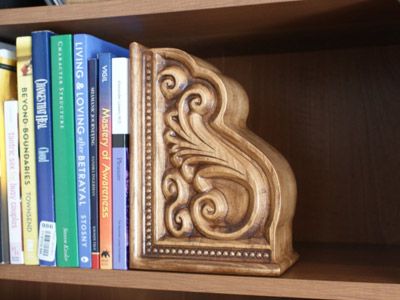
Nous remercions chaleureusement Andy et Marty d'avoir pris le temps, malgré leur emploi du temps chargé, de rédiger cet article. Inscrivez-vous sur le forum des utilisateurs de Vectric pour découvrir d'autres projets inspirants de l'atelier de menuiserie Locust Lane, comme ceux présentés dans les quatre images ci-dessous. Il est important de noter que ces créations ont toutes été réalisées avec VCarve Pro et uniquement à l'aide de trajectoires d'outil 2D et 2,5D, et non de modèles 3D !

Vectric Ltd
Precision House
2 Arden Road
Alcester
B49 6HN
Immatriculée en Angleterre sous le numéro 05382596
Immatriculation à la TVA GB115123072
Politique de confidentialité |
Politique relative aux cookies |
Termes et conditions



