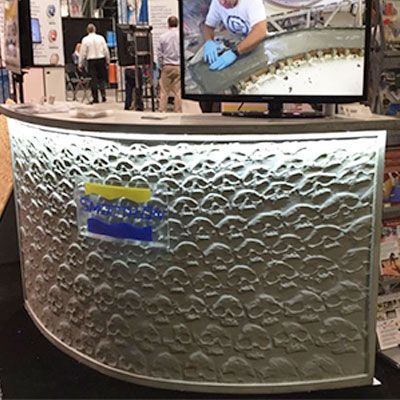
At this year’s US User Group Meeting, David Stubbs from Finishing Touch Frames showed us a picture of an extraordinary desk he’d made using Aspire and his Laguna CNC Router. The desk, for use at a trade show, had a curved front made from molded concrete that was covered in skulls! The process to make this was intriguing so we asked David if he could tell us a bit more about how this unique project was created…
David started by explaining how he initially got involved:
I have a friend, Eric Pottle, who owns a concrete counter top company called Concrete Interiors. The manufacturer of the concrete they use wanted someone to make a desk for a Concrete Trade Show that they attend in Las Vegas. They didn’t want just any desk though; they wanted the face of the desk to be curved and also covered in skulls! After discussing it with my friend I thought this was something we could get involved with.
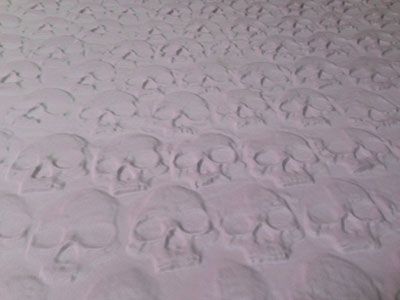
The initial stage was to model the skull shapes in the software, David told us what the process was for this:Zuerst luden wir ein Bild von Schädeln in die Aspire-Software hoch. Anschließend erstellten wir die Schädelmodelle und glätteten sie. Danach begannen wir mit der Erstellung der Werkzeugwege für die CNC-Maschine. Das Modell wurde mit einem 1/8"-Kugelkopffräser bearbeitet, um gute Details zu erzielen. Da das Material so weich war, verzichteten wir auf einen Vorschliff. Das Herunterladen des Bildes, die Modellerstellung und die Erstellung der Werkzeugwege dauerten etwa zwei Stunden.
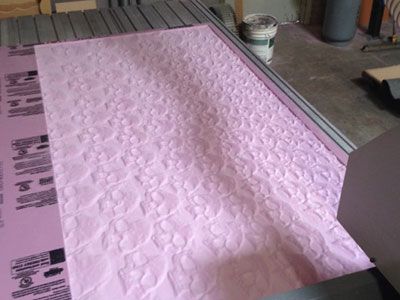
Nachdem die Werkzeugwege erstellt waren, folgte der nächste Schritt: das Fräsen des Teils auf der CNC-Maschine. David fährt fort:
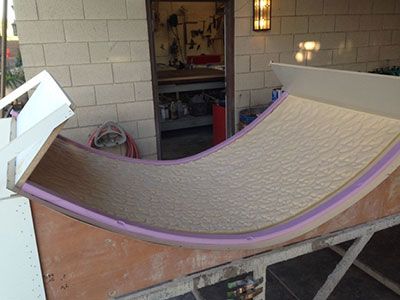
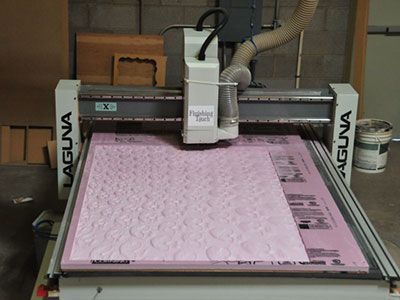
Wir schnitten das 3D-Modell aus einer rosa Schaumstoffplatte aus, die wir im örtlichen Baumarkt gekauft hatten. Diese wurde auf eine Trägerplatte geklebt. Da wir für die Größe des Teils ein relativ kleines Werkzeug verwendeten, dauerte der Fräsvorgang etwa 36 Stunden!Im letzten Schritt wurde das zugeschnittene Teil so geformt, dass es sich in die gebogene Form des Schreibtisches biegen und mit Beton begießen ließ. Dazu wurde ein vom Betonhersteller geliefertes Gummimaterial auf die Oberfläche des CNC-geschnittenen Isolierschaums gegossen. Nach etwa einem Tag Aushärtungszeit entstand eine wiederverwendbare Form. David erklärt weiter, wie daraus die Schreibtischfront aus Beton wurde:
Nachdem die wiederverwendbare Gummiform ausgehärtet war, wurde sie in eine speziell angefertigte, gebogene Vorrichtung gelegt, die die Form des fertigen Produkts vorgab. Die Betonmischung wurde in die Gummiform gegossen und aushärten gelassen. Nach 24 Stunden wurde der Beton aus der Gummiform entnommen und eine Tischplatte mit Beleuchtung angebracht. Fertig war der freistehende, maßgefertigte Totenkopf-Schreibtisch!As you can see from the image (see bottom of page - left) this created a striking display for the trade show booth and also showcased how a number of different technologies and processes can come together to make something unique. Interestingly though this type of thing is not typical of what David is involved in day-to-day but does show the potential to expand into other areas if you utilize CNC technology.
David’s main business focuses on finishing he does also make a number of different CNC based products, offered for sale on the internet. To finish our case-study we asked him to tell us a bit about his history, whether he has any tips for people starting with the software and finally what he’s working on now.
He explained to us that his interest in wood work started when working with his dad who was a carpenter:
My dad was old-school, he did everything by hand. He taught me the basics such as how to make jigs and get the job done with what you had.David took his initial interest and developed it into a career, he now has over 30 years professional experience, originally painting and staining shutters and later working on custom cabinets. The company was founded in 2001 and they added the CNC at the start of 2012. Initially they bought VCarve Pro with their machine as that was recommended to them by Laguna and then upgraded to Aspire in August 2013 to add more 3D functionality. David explained to us that this has increased the potential for what they can do in the business:
Since using the Vectric software accompanied by the CNC, it has opened up a whole new world for me. Like we did with the skull desk it’s nice to be able to use more of our imagination on projects and help the customer get what they want.
When asked for any tips or recommendations for people who are new to the software and CNC, he suggested:Achten Sie unbedingt auf die Werkzeugwegvorschau und überprüfen Sie Ihre Arbeit sorgfältig, um keine CNC-Zeit und kein Material zu verschwenden. Sehen Sie sich die Vectric-Tutorials an; sie enthalten viele hilfreiche Informationen. Und schließlich: Berechnen Sie Ihre Arbeitszeit angemessen!
Zum Schluss haben wir David gefragt, woran er gerade arbeitet:
Ich arbeite an meinem neuen Empfangstresen (siehe unten rechts). Ich habe ihn in Aspire entworfen und mit meiner CNC-Maschine ausgeschnitten. Anschließend habe ich ihn um eine gebogene Sperrholzkonstruktion gewickelt, die ebenfalls mit der CNC-Maschine zugeschnitten wurde. Außerdem fertige ich ständig Bilderrahmen und andere Holzprodukte an, die wir online verkaufen können.
Wir bedanken uns herzlich bei David für die Vorstellung seines interessanten Produkts. Wenn Sie mehr von Davids Arbeiten sehen oder mit ihm in Kontakt treten möchten, besuchen Sie bitte www.finishingtouchframes.com.

Vectric Ltd
Precision House
2 Arden Road
Alcester
B49 6HN
Eingetragen in England unter der Nummer 05382596
Umsatzsteuer-Identifikationsnummer GB115123072
Datenschutzerklärung |
Cookie-Richtlinie |
Allgemeine Geschäftsbedingungen



