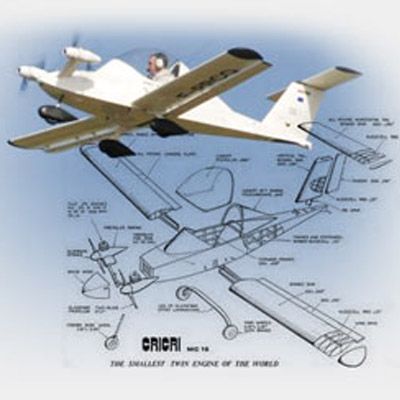
Shannon Walls a acheté sa première fraiseuse CNC en Chine il y a environ deux ans et demi. Après s'être initialement contenté du logiciel CNC fourni avec sa machine, il a rapidement été très frustré par ses limitations et ses nombreux bugs, ce qui l'a amené à explorer d'autres options logicielles, comme il le décrit ;
“I was looking on the forums and saw that a lot of the other sign makers were using VCarve Pro. I tested the trial version and I was suitably impressed with the ease of use and also its great features. Eventually I purchased VCarve Pro and Cut3D along with PhotoVCarve and although I haven't used PhotoVCarve much yet , VCarve Pro gets used just about every day.”
Shannon runs a successful, custom CNC routing service by day, but in his spare time he uses the machine to tackle various personal projects. In fact, soon after learning the CNC basics Shannon decided to take on a very ambitious project; to machine and build a form of light aircraft called a CriCri. Shannon agreed to share his reasons for taking on the challenge and his experiences in using Vectric software.“The story behind my decision to build a CriCri goes back to a Classic fighters airshow in Omaka in 1995. It was there that I first saw the CriCri that Nev Hay has built. I was fascinated by the tiny aircraft. In fact it was very close to the plane I had dreamed about making when I was 12 years old.”
However, Shannon also explains that after he heard that the plane he saw took 2000 hours to build he was instantly put off, that is until he later discovered CNC machining and VCarve Pro.
More than ten years later and owning a large CNC machine, Shannon stumbled across the plans of the CriCri on the internet for download.
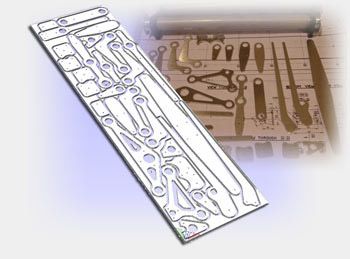
“Once looking over them I realised that it would be the perfect aircraft as a CNC project. I purchased a licensed set of plans from someone in Australia who was selling their set and got to work redrawing all the parts in CAD ready to CNC cut.”Shannon a d'abord dessiné les pièces dans un logiciel de CAO qu'il maîtrisait déjà, puis les a importées dans VCarve Pro pour les imbriquer dans la tôle, comme vous pouvez le voir dans l'exemple à droite.
Shannon a importé et découpé plus de 1 000 pièces dans VCarve Pro pour ce projet.
Un exemple de pièce est visible ci-dessous : le plateau de pédales.
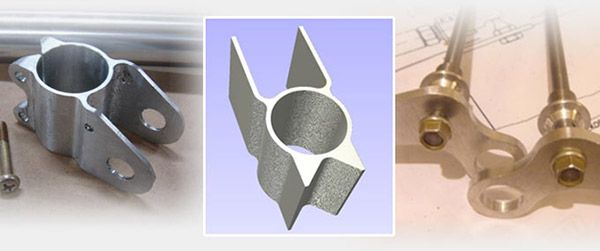
Certaines pièces, comme les supports moteur et les charnières de l'élévateur, ont dû être découpées dans un lingot d'aluminium 2024T351 de 32 mm d'épaisseur. Cela a nécessité un enlèvement de matière important ; j'ai utilisé la fonction de dégagement pour enlever la majeure partie de la matière, puis une passe de profilage pour obtenir une bonne finition.
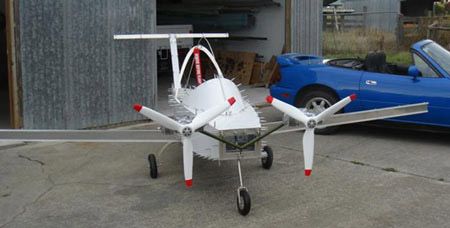
La plupart des pièces sont finies à la main par ébavurage et ponçage pour un aspect mat. Shannon a largement utilisé les fonctions d'imbrication et de prévisualisation des trajectoires d'outils 3D de VCarve Pro pour s'assurer que le résultat final corresponde à ses exigences.Comme Shannon construit cet avion sur son temps libre, la production est toujours en cours. Voici l'avion dans son état actuel (23 novembre).
Pour suivre ce projet incroyable, veuillez consulter le récit de sa construction dans ce fil de discussion.
Un grand merci à Shannon pour avoir partagé son histoire et bonne chance pour la suite du projet !
« Je tiens à remercier Vectric d'avoir créé un logiciel aussi puissant, mais aussi agréable et facile à utiliser. VCarve Pro simplifie considérablement mes projets CNC. »
Shannon
http://www.remain.co.nz/

Vectric Ltd
Precision House
2 Arden Road
Alcester
B49 6HN
Immatriculée en Angleterre sous le numéro 05382596
Immatriculation à la TVA GB115123072
Politique de confidentialité |
Politique relative aux cookies |
Termes et conditions



